

Are SARMs Stronger Than Peptides? Muscle Growth, Results, and Risks Compared
Are SARMs stronger than peptides?
SARMs may have more direct human research demonstrating increases in lean body mass than many experimental peptides marketed for bodybuilding, but that does not mean SARMs are universally stronger or better. The answer depends on the specific compound and what you mean by “stronger.”
SARMs, including ostarine, are designed to act on androgen receptors. Peptides are a broad category of molecules that can influence many different biological processes. Some affect hormone signalling, while others are investigated for different medical or biological purposes.
This distinction matters because building muscle, increasing strength, reducing body fat, and recovering from an injury are different outcomes. A compound that changes hormone levels does not automatically produce more muscle, and an increase in lean body mass does not necessarily translate into a meaningful improvement in strength.
In this guide, we’ll compare the available human evidence, explain the differences between SARMs and peptides, examine their risks, and separate scientific findings from personal experiences and online claims.
What are SARMs?
SARMs stands for selective androgen receptor modulators. These are synthetic, non-steroidal compounds designed to interact with androgen receptors, which respond to hormones such as testosterone.
Androgen signalling plays a role in muscle and bone physiology. Researchers developed SARMs partly in the hope of producing certain beneficial effects of androgen signalling while reducing unwanted effects in other tissues.
However, selectivity does not mean that a compound affects only muscle, nor does it guarantee safety.
Three commonly discussed SARMs are:
- Ostarine (enobosarm or MK-2866): Investigated for its effects on lean body mass and muscle wasting.
- LGD-4033 (ligandrol): Studied for its effects on lean body mass, hormone levels, and safety.
- RAD-140 (testolone): An investigational SARM that is popular in bodybuilding discussions but lacks established evidence supporting safe, effective bodybuilding use.
These compounds are not interchangeable. Evidence for one SARM should not automatically be applied to another.
For more detail, consult the published research on enobosarm in older adults and the LGD-4033 clinical trial.
What are peptides?
Peptides are short chains of amino acids. Depending on their structure, they can act as signalling molecules or influence biological pathways involved in processes such as metabolism, hormone release, and tissue function.
The word peptides describes a broad molecular category, not a single drug with a single effect.
Examples discussed in fitness and wellness communities include:
- CJC-1295: A growth-hormone-releasing hormone analogue studied for its effects on growth hormone and IGF-1 levels.
- Ipamorelin: A compound that acts on growth-hormone secretagogue receptors.
- BPC-157: An experimental peptide frequently marketed with tissue-repair and recovery claims.
- TB-500: A product name associated with thymosin beta-4-related research and marketed for recovery, although the identity and composition of products sold under this name may vary.
The evidence differs substantially across these compounds.
Some peptides are approved medicines for specific medical conditions. Others are experimental substances without established clinical uses or adequate human safety data.
For example, a peptide that stimulates hormone release is biologically different from one being investigated for tissue repair. Neither should automatically be considered a proven muscle building treatment.
SARMs vs peptides: What does the research show?
The most useful comparison is based on measurable outcomes
| Question | SARMs | Peptides |
|---|---|---|
| Do human studies exist? | Yes, for several compounds, including ostarine and LGD-4033 | Yes for some peptides, but the amount and quality of evidence vary widely |
| Is increased lean body mass documented? | Yes, in some clinical trials | Evidence depends on the specific peptide; many bodybuilding claims lack strong human evidence |
| Is greater strength guaranteed? | No | No |
| Are injury-recovery claims established? | Not as a general property of the class | Not as a general property of the class |
| Is long-term safety established for bodybuilding use? | No | No; it varies by compound, and many experimental products have inadequate data |
| Are all products in the category approved medicines? | No | No; some peptides are approved medicines, while others are experimental or unapproved |
The main takeaway is that SARMs have direct human research demonstrating effects on lean body mass for certain compounds. For many experimental peptides promoted for bodybuilding, evidence supporting comparable outcomes is much less developed.
That difference in evidence should not be mistaken for proof that every SARM produces greater results than every peptide.
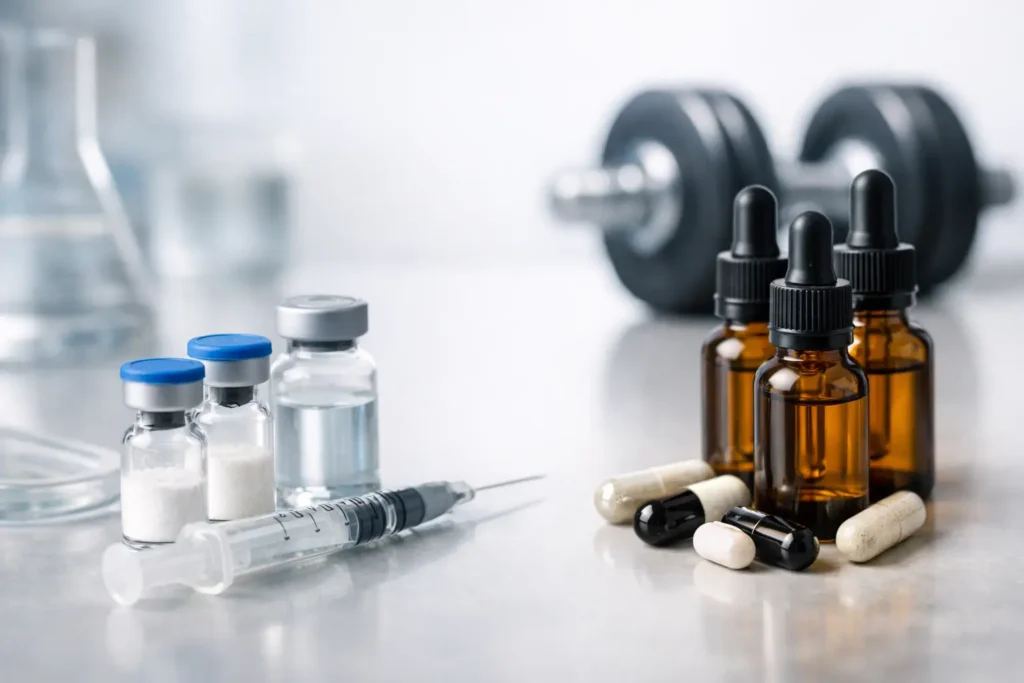
1. Which is stronger for muscle growth?
Ostarine provides a useful example of what human research can and cannot tell us.
A randomised, placebo-controlled phase II trial examined enobosarm in older men and postmenopausal women. Over 12 weeks, researchers observed dose-related increases in lean body mass, with statistically significant findings in the higher-dose group compared with placebo.
The study is important because it measured body composition in humans rather than relying exclusively on animal research or user reports.
However, the participants were not representative of every healthy young bodybuilder, and the findings do not establish long-term safety or the results someone should expect outside a clinical trial.
Read the published enobosarm trial.
A separate randomised trial studied LGD-4033 in 76 healthy men over 21 days. Researchers found increases in lean body mass, alongside changes in some hormonal and lipid measurements. The study was short and was not designed to establish the long-term safety of recreational use.
See the LGD-4033 study published in 2013.
What about peptides? Certain hormone-related peptides have demonstrated biological activity in humans. But increasing a hormone or biomarker is not the same as proving that a compound produces substantial muscle growth or improves physical performance.
For example, a clinical study of CJC-1295 found increases in growth hormone and IGF-1 levels in healthy adults. Those findings demonstrate hormonal effects; they do not establish that CJC-1295 produces greater muscle gains than ostarine.
The relevant CJC-1295 clinical study illustrates why it is essential to distinguish a biological effect from a proven bodybuilding outcome.
Verdict for muscle growth: Certain SARMs have more direct clinical evidence for increasing lean body mass than many experimental peptides promoted for bodybuilding. However, the available studies do not justify declaring SARMs universally stronger or recommending them for recreational muscle building.
2. Which is better for strength?
Muscle size and strength are related, but they are not identical.
Strength depends on several factors, including muscle size, nervous-system adaptation, technique, training history, fatigue, and the movement being tested.
A study that reports an increase in lean body mass has not necessarily demonstrated a comparable increase in lifting performance. Likewise, an increase in growth hormone or IGF-1 does not prove that a person will become stronger.
When evaluating claims about either category, look for trials that measure actual physical performance rather than relying on body-composition scans, hormone tests, or photographs alone.
There is no reliable basis for ranking every SARM above every peptide for strength. The specific compound, population studied, outcome measured, and quality of the evidence all matter.
3. What about fat loss and body composition?
Changes in body weight, fat mass, lean body mass, and muscle size are different measurements. Lean body mass includes more than skeletal muscle; it can also reflect water and other non-fat tissues.
A person may experience a change in lean body mass without gaining an equivalent amount of contractile muscle. Similarly, a change in body weight does not establish that body fat has decreased.
Some peptides are studied for specific metabolic or medical purposes, but that does not mean every peptide promotes fat loss. Likewise, evidence of lean-body-mass changes with a SARM does not establish that it is an effective or safe fat-loss treatment.
For a meaningful comparison, ask whether a controlled human study measured changes in body fat, lean mass, and relevant health outcomes—not merely whether a seller describes a compound as “cutting” or “leaning.”
4. Which is better for recovery and injury repair?
Recovery claims deserve particular scrutiny because they are often based on laboratory research, animal experiments, and personal testimonials.
BPC-157 is a common example. Research in experimental models has investigated biological processes related to tissue healing, but promising preclinical results do not establish that a substance reliably treats injuries in humans.
The same principle applies to TB-500 and other products marketed for recovery. Researchers must establish what the product contains, whether it has been tested in appropriately designed human studies, and whether it improves meaningful clinical outcomes.
It is also important to distinguish normal post-workout recovery from treatment of an actual injury. Evidence supporting one outcome would not automatically prove the other.
Verdict for recovery: Neither SARMs as a class nor peptides as a class can be declared the better recovery option. Claims about particular experimental peptides often go beyond what the available human evidence establishes.
5. What are the side effects and risks?
This is where a responsible comparison must go beyond performance claims.
Risks associated with SARMs
The US Food and Drug Administration (FDA) warns that SARMs marketed for bodybuilding are unapproved drugs, not ordinary dietary supplements.
Read the FDA’s warning on bodybuilding products containing SARMs.
A person feeling well while using a compound does not rule out changes in cholesterol, hormone levels, liver function, or other health markers. Some problems may not produce obvious symptoms at first.
Risks associated with peptides
Safety depends on the particular molecule, its biological activity, the route of administration, the quality of the product, and the evidence available.
Injection also introduces risks such as infection and contamination when products or equipment are not appropriately controlled.
The important point is not that every peptide has the same risks as SARMs. It is that the safety of an individual peptide must be evaluated on its own evidence, rather than assumed from the category name.
6. A real-world ostarine experience: What can we learn?
Someone known personally reported using ostarine with the goal of increasing muscle growth. According to the account shared, the individual felt the compound worked and was very happy with the result, reporting that they felt okay.
This is an anecdotal account, not a clinical case study.
There are no independently verified measurements, detailed medical assessments, documented product analyses, or follow-up data available for this account. We therefore cannot establish how much muscle the person gained, whether ostarine caused the reported outcome, or whether there were unrecognised health effects.
The experience is still useful for illustrating why these compounds attract interest. A person may feel satisfied with a perceived result, but personal satisfaction cannot answer the broader questions of effectiveness, causation, product quality, or long-term safety.
It would be misleading to turn this account into a claim that ostarine works for everyone or that it is safe because one person reported feeling well.
That distinction is particularly important when reading online testimonials. Experiences can provide context, but controlled research is better suited to determining whether an effect is reproducible and what risks may accompany it.
7. Are SARMs and peptides legal in the USA and UK?
Regulatory status depends on the substance, its intended use, the product, and the jurisdiction.
United States
The FDA states that SARMs marketed for bodybuilding are unapproved drugs and are not lawful dietary supplements simply because they are sold under that label.
Peptides are a broader category. Some are approved medicines for particular indications, while others have not received approval for the uses promoted online. Compounding rules and the legal status of particular substances require product-specific assessment.
United Kingdom
In the UK, a product’s status depends on applicable medicines legislation and its authorisation. The Medicines and Healthcare products Regulatory Agency (MHRA) provides guidance on the supply of unlicensed medicinal products and maintains a register of authorised online medicine sellers.
The existence of a website, a “research use only” label, or a product listing does not by itself establish that a product may lawfully be marketed for human consumption.
See the MHRA’s guidance on supplying unlicensed medicinal products and its register of authorised online medicine sellers.
Athletes should also check the current prohibited list and applicable rules of their sporting organisation, as a substance’s legal status and its status in competitive sport are separate questions.
Because regulations can change, readers should check current official guidance before making decisions.
8. What should you consider before trusting performance claims?
Whether you encounter a SARM or a peptide, use the same evidence-based questions.
1. What exact compound is it?
A broad label such as “peptides” tells you very little about the intended effect or the safety evidence.
2. Has it been studied in humans?
Animal experiments can help researchers understand possible mechanisms, but they cannot establish that a product is effective or safe in people.
3. What outcome was actually measured?
Muscle size, lean body mass, strength, recovery, and hormone levels are not interchangeable.
4. Who participated in the study?
Results from people with a particular medical condition or age group may not apply to healthy athletes.
5. How long were participants followed?
Short-term studies cannot reliably establish long-term safety.
6. Is the product’s identity and quality verified?
Online marketing claims are not proof of purity, accurate labelling, or regulatory compliance.
7. Are the claims stronger than the evidence?
Be cautious of guaranteed results, claims of no side effects, or testimonials presented as if they were clinical proof.
For people whose goal is muscle growth, progressive resistance training, adequate nutrition, sleep, and consistency remain foundational. Anyone considering an experimental performance-enhancing substance should discuss the risks with a qualified healthcare professional rather than relying on a seller’s claims.
Frequently asked questions
Are SARMs stronger than peptides for building muscle?
There is no universal answer. Some SARMs have direct human evidence showing increases in lean body mass, whereas many experimental peptides marketed for bodybuilding lack comparable clinical evidence. The result depends on the specific compound and outcome.
Is ostarine stronger than CJC-1295?
The available evidence does not support a simple head-to-head conclusion. Ostarine has been studied for lean body mass, while CJC-1295 research has demonstrated effects on growth hormone and IGF-1. These are different outcomes, and evidence of hormonal activity does not prove superior muscle growth.
Do peptides build muscle?
Some peptides affect biological pathways related to hormones and metabolism, but their effects vary. A peptide’s mechanism or an increase in a biomarker does not establish that it produces meaningful muscle growth in humans.
Are peptides safer than SARMs?
Not as a general rule. Some peptides are approved medicines with established uses, while others have limited safety information. SARMs marketed for bodybuilding also carry serious documented concerns. Safety must be assessed for the specific substance and product.
Does feeling fine on ostarine mean it is safe?
No. The absence of noticeable symptoms does not rule out changes in health markers or less obvious adverse effects. One person’s experience cannot establish long-term safety.
Are SARMs steroids?
SARMs are not the same chemical class as anabolic steroids, although they interact with androgen receptors and are often marketed for similar physique-related goals. Their non-steroidal structure does not make them risk-free.
Can peptides help with injury recovery?
Some experimental peptides have shown promising findings in laboratory or animal research. However, those findings do not establish that they safely or reliably treat injuries in humans. Check the evidence for the specific substance and medical condition.
Are SARMs approved by the FDA for bodybuilding?
No. The FDA warns that SARMs marketed for bodybuilding are unapproved drugs and should not be treated as ordinary dietary supplements.
Final verdict: Which is stronger?
SARMs and peptides are too different to rank as entire categories on a single scale.
For muscle growth, certain SARMs—particularly ostarine and LGD-4033—have direct human clinical evidence demonstrating increases in lean body mass in specific study populations. Many experimental peptides marketed for bodybuilding have less convincing human evidence for muscle growth, even when they demonstrate biological activity.
For strength, fat loss, recovery, and safety, the answer depends on the particular compound and the quality of the evidence. Neither category can be declared universally superior or safe.
The most useful question is not simply “Which is stronger?” It is “What has been demonstrated in humans, for which outcome, and at what risk?”
That is the distinction between an attractive marketing claim and an evidence-based decision.
Medical disclaimer: This article is for educational purposes only and is not medical advice. It does not recommend the use of SARMs or experimental peptides. Consult a qualified healthcare professional for advice about health concerns or treatment options.